

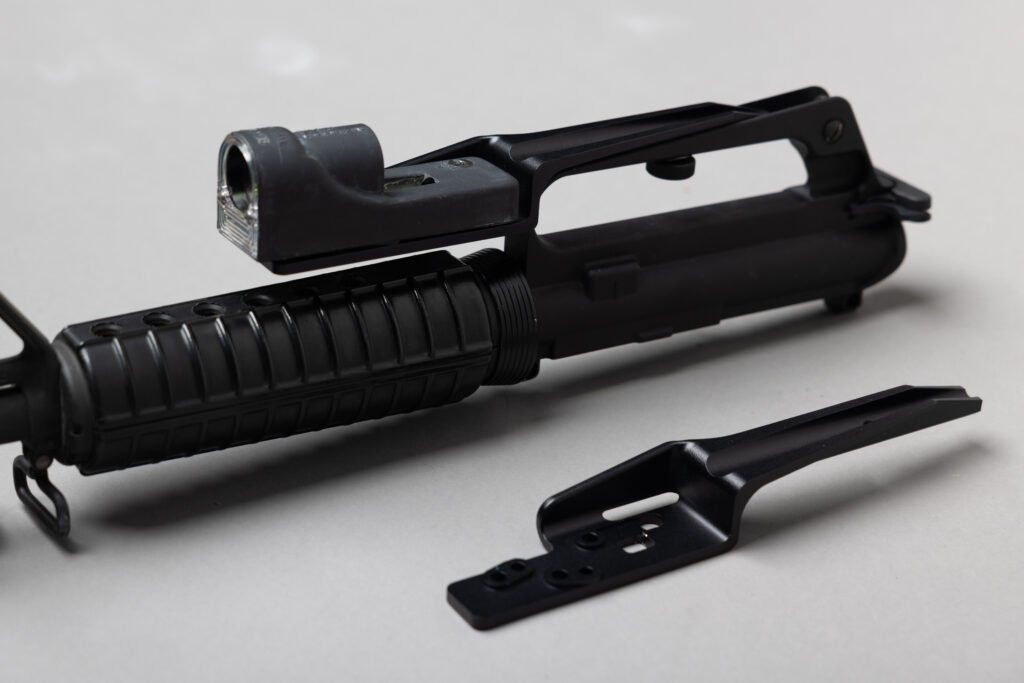
An optic of many names, RX-01, Reflex, Grandpa M21, ACOG (not the ACOG ACOG).
To talk about the RX-01 is to talk about an era before shooters trusted microelectronics, before “50,000-hour battery life” became the industry’s version of a late-night infomercial promise. Back when the rifles were heavier, the rails were sharper, and the idea of an optic that needed to be turned on felt faintly ridiculous, like a flashlight that refused to shine unless you typed your PIN number into it.
The RX-01 entered this ecosystem not as a technological revelation but as a sort of contrarian rebuttal to technological revelation. It was a red dot that didn’t want to be a red dot, at least not in the modern sense. There were no batteries to leak, no rheostat dial to twiddle, no LEDs humming faintly with all the menace of a future failure. Instead, it relied on a kind of primitive magic: fiber optics that siphoned ambient light during the day, and tritium, literally glowing nuclear material in the smallest possible quantity, after dark. A sight that glowed because the universe said so, not because a circuit told it to. The RX-01’s appeal was durability through simplicity.
Trijicon had already made a name for itself with the Advanced Combat Optical Gunsight (ACOG) series, which used dual-illumination fiber optics by day, tritium by night to power a bright, self-adjusting reticle. The RX-01, sometimes called the Trijicon Reflex, applied that same principle to a non-magnified red-dot-style optic.
At the time of release, flat-top AR-15s weren’t even a custom shop thing, so the only real way to mount an RX-01 on an AR platform rifle (or much more likely your piece of crap issued M16A2) was on a gooseneck mount, cantilevering your dot towards the handguard and giving you the oh so popular at the time cowitness.
As the 90s came and went, Trijicon attempted to keep the dot relevant, releasing a variety of mounts for other platforms, though LED-based red dots developed dramatically. By the mid-2010s, the RX-01 had ceased to be contemporary and instead became historic, which is the polite way of saying that newer products did almost everything better. And yet something about it remains compelling: its stubborn refusal to rely on anything more complex than physics; its immune-to-obsolescence aesthetic; its quiet insistence that if you point the rifle, the reticle will be there, whether you planned for it or not.
Although to some, the idea of an optic that never really needed any servicing sounded like a lovely idea, particularly the IDF was very fond of the dot, leading Meprolight to create its own equivalent, the M21.

Of course, both of these dots suffer from the same pitfalls. Under certain lighting conditions, the reticle can wash out, disappearing in a way that feels almost existential, as though it is briefly contemplating its own purpose. Shooters have developed all sorts of folk solutions for this, and both Trijicon and Meprolight offer attachments that beam light straight into the fiber optic to keep the dot stimulated.
Nowadays, the RX-01 lives on as a dot for collectors of more obscure builds, as its aesthetics are undeniable. The M21 though, lives on and still sees widespread formal use in Israeli forces. Meprolight has since created an updated version lazily dubbed “M22.” I had a chance to try the M22 before, and I can say I was baffled by the decision to shield the fiber optic, which led to a hilariously washed-out dot in most indoor and outdoor use.
In this way, the RX-01 is less an optic and more a philosophical position, an argument for simplicity in an increasingly electrified world. It represents a moment in firearm history when shooters weren’t yet sure they trusted the future, and so they bought something that didn’t need the future at all.
KernOptic now sells reproductions of that famous gooseneck on their website for those who want to keep the cult of the RX-01 alive.